
Transcription
- Input
- Audio, video, voice messages, recorded interviews and broadcasts
- Output
- Time-coded transcript in the original script
- Check
- Names, numbers and dates checked by a second linguist
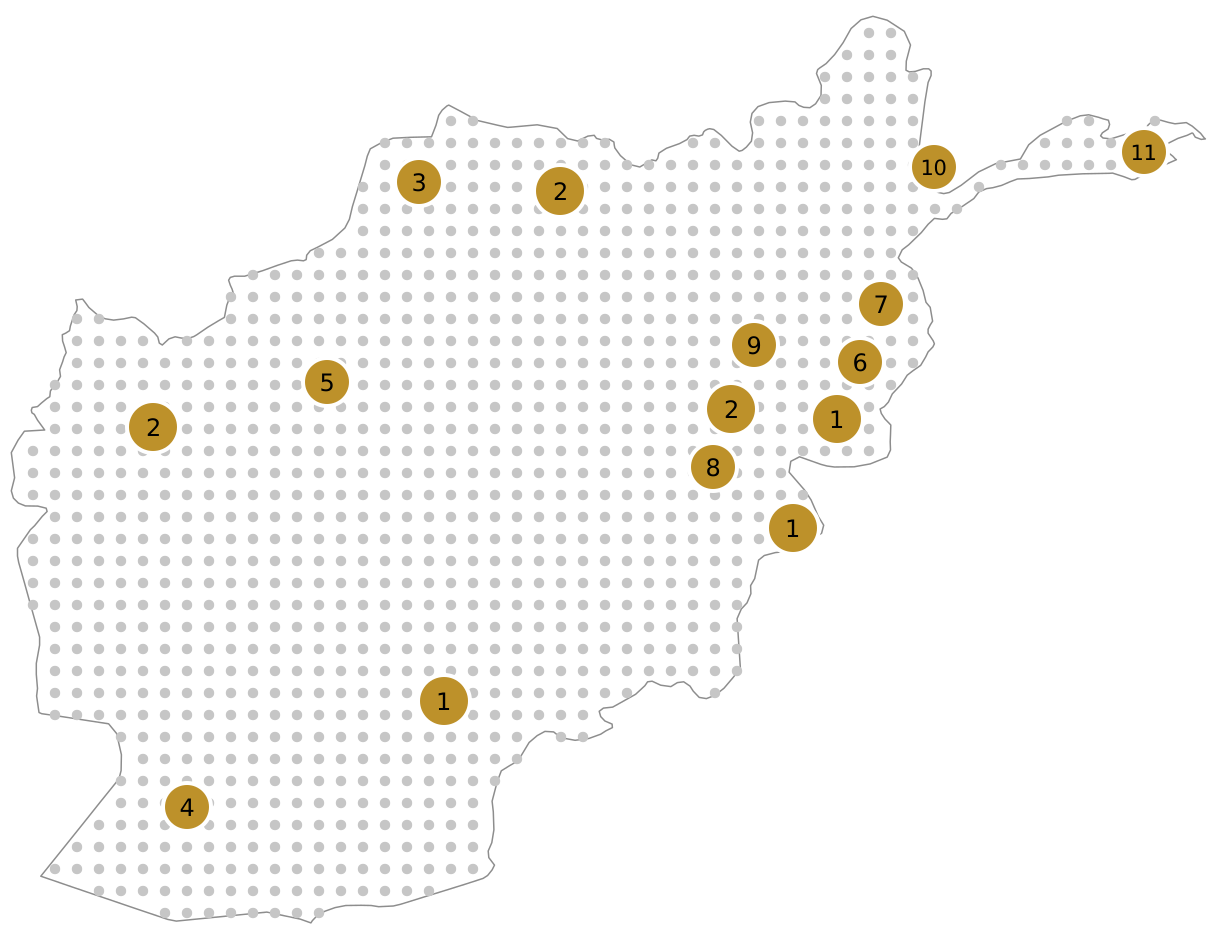
Pashto and Dari linguists, and linguists in 22 more Afghan languages, for defense and intelligence programs. On cleared work, every linguist is a U.S. citizen who holds current eligibility at the level your contract requires, or is processed for it once your program sponsors our facility clearance. Every one is university-educated and assessed in the exact variety on your material.
For the Department of War (DoD) and the military services, the intelligence community, federal law enforcement, the cleared prime contractors that support them, and allied and partner governments.
د ننګرهار ولایت د ترافیکو ریاست اعلان وکړ چې د تورخم لویه لاره به سبا له سهاره تر ماښامه د ترمیم له امله تړلې وي.
Afghan languages
more working languages
security tiers
citizens only
Ariana Nexus, a Washington, D.C. consulting and professional services firm, provides Pashto and Dari linguists, and linguists in 22 more Afghan languages, for defense and intelligence programs. They transcribe, translate, gist and analyze audio, video, documents and digital media. Classified work is done only by U.S. citizens who hold current eligibility or are processed for it, under a facility clearance sponsored by the agency or prime contractor with the classified requirement.
Four work products, each defined before work starts, so what you receive matches what your analysts and your contract expect.
The same fifteen seconds of Pashto radio, delivered three ways. You choose the product; we tell you when the material needs more than you ordered.
د ننګرهار ولایت د ترافیکو ریاست اعلان وکړ چې د تورخم لویه لاره به سبا له سهاره تر ماښامه د ترمیم له امله تړلې وي.
مسافرو ته سپارښتنه شوې چې خپل سفرونه مخکې له مخکې پلان کړي.
We work at three levels. Each has its own people, systems and paperwork, agreed before the first file moves.
CAT I
CAT II
CAT III
The variety on the recording decides who works on it. Kandahari and Nangarhari Pashto, and Kabuli, Herati and Hazaragi Dari, differ in vocabulary, names and idiom. For cleared work in the smallest languages, a qualified U.S. citizen linguist may not exist; we tell you before you commit.
په پښتو او دري ژبو کې ژباړه، لنډیز او تحلیل
ترجمه، خلاصه و تحلیل به زبانهای پشتو و دری
Six steps, the same on every tasking. The gold marks are the two quality gates.
University-educated linguists, not just bilingual speakers. Our linguists come from the Afghan community, hold university degrees and are assessed in the variety they work in.
The rules this service is built around, what each covers, and how we apply it. Status as of 26 September 2026.
32 CFR Part 117 (NISPOM)
SEAD 4 and SEAD 3
Trusted Workforce 2.0
DFARS 252.204-7012 and NIST SP 800-171 Rev. 2
CMMC (32 CFR Part 170)
ITAR (22 CFR 120.62)
DoDD 3300.03 and ICD 302
GDPR and UK GDPR

Our leadership is named below. Our linguists are not named on this page: on defense and intelligence work, their anonymity is part of the security.


Unclassified or open-source Pashto and Dari
CUI Pashto and Dari
Classified, linguist holds current eligibility
Classified, new eligibility
Smaller Afghan languages
A cleared linguist holds current eligibility for access to classified information at the level a contract requires, typically Secret (CAT II) or TS/SCI (CAT III) on U.S. programs. Eligibility is granted by the government, not by an employer, and a personnel security clearance requires U.S. citizenship.
Yes, in two ways: linguists who already hold current TS/SCI eligibility, and U.S. citizen linguists processed for it once the agency or prime contractor with the requirement sponsors our facility clearance under 32 CFR Part 117. We tell you each candidate’s route before you commit. Polygraph requirements are set by your customer.
Gisting is a short summary translation: an English account of who, what, where and when in a piece of material, written so an analyst can decide what needs full translation. The ILR excludes gisting from its translation standard because it takes different skills, so we assess it separately.
Transcription writes down what was said in the original language and script, with time codes and speaker turns. Translation renders it in English. Most intelligence work needs both: the transcript preserves the source, and the translation makes it usable.
Only as triage, and only inside the controlled environment the work requires, never a public AI service. Off-the-shelf Whisper models scored above 100% word error on Pashto in a 2026 study, so a linguist checks every line that reaches you. Customer material is never used to train any model.
No. Afghan Dari and Iranian Persian (Farsi) share a script and much grammar but differ in vocabulary, names and usage; Afghan Dari says “estekhbarat” for intelligence where Iranian Persian says “ettela’at.” We assign Dari linguists to Dari material and tell you when material is Iranian Persian or Tajik.
All 24: Pashto, Dari, Aimaq, Balochi, Ormuri, Parachi, Wakhi, Shughni, Sanglechi, Ishkashimi, Munji, Yidgha, Uzbeki, Turkmeni, Kyrgyz, Pashayi, Gawarbati, Tirahi, Nuristani (Ashkun group), Kati, Prasun, Waigali, Tregami and Brahui. Within Pashto and Dari we match the variety as well: Kandahari, Nangarhari and other Pashto varieties, and Kabuli, Herati, Hazaragi and other Dari varieties.
Our raters assess each linguist against the ILR skill level descriptions in the specific variety they work in, for listening, reading and translation, and assess gisting separately. Ratings are internal, recorded per variety and per skill, and mapped to NATO STANAG 6001 levels for allied programs; official STANAG ratings come from national testing authorities.
Yes, after export-control scoping. U.S. clearances do not transfer to non-U.S. programs, so national security vetting is sponsored by your government, and European personal data is handled under GDPR or UK GDPR terms agreed before transfer.
No. We have no offices or staff in Afghanistan, and we do not route documents, data or requests through channels controlled by the de facto authorities.
We do not publish their names, faces or clearance levels, and access to each tasking is limited to the people working on it. Linguists who work on graphic material follow exposure limits, rotation and scheduled debriefing.
They are linguist categories used in Army contracts. CAT I linguists hold no clearance, CAT II linguists are U.S. citizens with Secret eligibility, and CAT III linguists are U.S. citizens with TS/SCI eligibility. Your contract’s definitions govern.
For work involving CUI on DoD contracts, NIST SP 800-171 Rev. 2 safeguarding under DFARS 252.204-7012 applies now. The Phase II requirement for third-party CMMC Level 2 certification was suspended on 13 July 2026 pending review, and DFARS class deviation 2026-O0025, Revision 3, issued 3 September 2026, directs contracting officers to accept self-assessments meanwhile. A current self-assessment score posted in SPRS remains a condition of CUI work.
Send the tasking through our Initiate page with the security tier, languages, volume and deadline. We reply within one business day with a scope, the paperwork the tier needs and linguist availability.
Tell us the security tier, the languages, the volume and the deadline. We reply within one business day.